


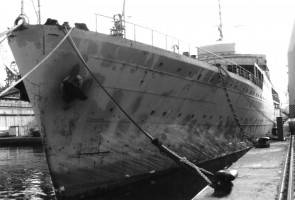
 galeb
galeb
I remember the fear that someone might have heard us and an attempt to reconstruct the words we had said before two unknown men knocked on the door of our four-bunk room in the Yugoslav National Army’s Home in Tivat. We were afraid because no one could get into the premises without a permit so we wondered how could two middle-aged men in tracksuits walk freely about the object that belonged to the military, that was heavily guarded and whose premises were partly closed to visitors. We tried to remember what we had said last because two “younger officers” from Galeb that was anchored in front of the Army Home in Tivat came to our room. It was the spring of 1991 and Yugoslavia was falling apart. In the actually very luxurious premises of the most modern army home ever built in Yugoslavia, right next to the “SA-KO” (Sava Kovačević) Naval Shipyard, my colleague and I were having one of our endless debates about politics. I a sailor, he in his green uniform. I from Croatia, he from Belgrade. He a nephew of at the time mostly unknown leader of FC Red Star supporters, but actually a fan of FC Partizan. I cheered for FC Dinamo and was very political. The two unknown men spoke in “Yugoslav” language. One was obviously from Macedonia, both of them were ensigns. The famed ship travelled along the coast from the Northern Adriatic to the Boka Military and Naval Sector and transported sailors who had completed their basic training in Pula. Those who were to be stationed in Bar, Kumbor or Radoviće-Tivat had it the worst because they were the last ones to come out and the first to enter the insides of the old boat. This meant a long, uncomfortable journey.
The arrival of the two low-ranked officers in a place where they were not supposed to be, to our surprise, ended up with an interesting offer. “We came to your house, now you can come look around ours.” And so after lunch, the three of us, crewmembers of Army Home Tivat, looked around Tito’s boat. The most important thing was that we could also see Tito’s rooms and Jovanka’s bathroom. Similar thing happened with the submarines that spent years on repairs at the “SA-KO” Naval Shipyard. The officers who looked after the vessels came to the Home to play billiards and in turn they showed us around a submarine or a ship. From the inside, Galeb was shocking. There was no sign of glamour, especially in the sailors’ quarters deep inside the ship. Tito’s premises were sealed off, they were not used. I was astonished by the ship’s restaurants, one for the officers, the other for lower ranks. The ship was barely armed.
Occasionally, the highest-ranked officers from Galeb came to eat at the Home’s restaurant. Captain Drnovšek from Slovenia came once, while Commander Jurić from Dalmatia who had an excellent voice came more often. Several years later there was an article in Feral Tribune about the Slovenian captain who was forced to leave his Split apartment at the time when housing problems in Croatia were dealt with differently than today or before the wars that brought an end to Yugoslavia began.
Fifteen years later I came back to Boka. The shipyard was closed; a millionaire from Canada bought the whole place and was planning to open a huge marina. He also bought the former Army Home, which was now closed and seemed somehow smaller than back in the 1990s, although still as ostentatious. With it Tivat lost its only movie theatre, its sports center. Galeb was also no longer in Boka. It was now in Rijeka, but I managed to get some information about the ship from a man who at Tito’s time served as the “security” officer in the base. Aco Milošević also told me a thing or two about Admiral Branko Mamula. Still at the door, the moment he entered the dining hall, Tito was known to ask Mamula: “Admiral, what’s that your men are eating?” putting him in an awkward position because Mamula was interested in “more important” things, not his men, so on one occasion he refused to look at the menu, as something marginal and unimportant, ephemeral. Everything he told me about Tito was positive. It was him who upholstered the couches in Tito’s quarters with wool coat fabric bought in Ljubljana. He told me how they rewired the cabin in order to power a small refrigerator so that Tito’s melon would always be cold. Galeb is the ship that took many of those who served on it to parts of the world they would have never seen otherwise. Some of them, such as my schoolmate’s father who was a tailor, learned their trade on Galeb and remained that for the rest of their lives. Obviously, Galeb was a special ship, a vessel that was part of my life even when I was not dealing with the Non-Allied Movement and Tito’s travels across the world.
I first heard that Galeb had been a ship used to transport bananas when I visited the Brijuni Islands and National Park. We were on a school trip to Pula and the story was told to me by Gašo, a friend from school. At the time the story seemed unreal. I didn’t believe what he told me, but it stuck in my memory. But Galeb, a fast diesel ship, with two Fiat engines, really was made on order from Genoa based Regia Azienda Monopoli Banane (RAMB) in 1938. Back then it was called RAMB III. It didn’t take long and the Italian Army turned it into a ship that transported meat to Lybia, a convoy escort. And it was in Benghazi, on June 30, 1941, that a British torpedo hit its bow. After the Italian captain Giuseppe Aneti distributed the load around the hold, the ship could sail, but only astern. And so the skillful captain somehow took RAMB III to Sicily and from there it was towed to San Marco Shipyard in Trieste. It was a true naval feat. In Trieste it saw Italy capitulate, and then the Germans turned it into a minelayer and renamed it into Kiebitz. Then, in November 1944, the Allied Air Forces bombed and sunk the ship. It disappeared in the sea in front of Rijeka after it had managed to plant thousands of mines in the Kvarner Gulf. Brodospas Company from Split resurfaced the ship in 1947 and 1948. At Uljanik Shipyard Company in Pula the ship was repaired: all of its parts and instruments were disassembled, cooked in fresh water to remove salt and other sedimentation. Despite all of its disasters, the engines never failed. The ship once again became a minelayer. It once again had tracks and cranes; only its name – “M-11” – was different. Istria ceased to be Italian and the ship was supposed to keep watch of those regions, M-11 could have planted 400 mines during one night.
A few years later the ship was remodeled. It no longer carried ammunition so it was built a 400-ton ballast tank. Both of the decks were extended, the ship got new cabins, classrooms, sleeping rooms for cadets, dining rooms, infirmaries, entertainment halls, an operation room, a hairdresser’s shop, shoemaker’s shop and a pastry. The ship became a training ship, but in fact it was Tito’s yacht. The supreme commander first stepped on its deck on September 10, 1952. In 1963 Captain Mate Jerković suggested to build a swimming pool for Tito, which he rejected. The only thing special about the ship were the high guests’ quarters, Marshal’s cabin made of bird’s-eye maple and Jovanka’s of white maple. The remodeled Galeb was now 117 meter long, 15.13 meters wide, with a draft of 5.7 meters and 5,377-ton displacement, it could reach the speed of 17.6 knots. The ship’s crew consisted of 120 sailors, 45 of which looked after the ship. Its two engines were as big as a house producing 2,500 horsepower each. The work of a machinist, in the heat higher that 40°C, was particularly difficult. So in 1961 Tito told the Captain of the Guard, General Milan Žeželj, that he had been down at the “machinery”. “By god, it pretty hot for the machinists down there. They should be given good food, rich in vitamins. You know that they have 48 to 50 degrees down there!” Special care and attention for the machinists is emphasized by everyone: from the said general and the Machinist’s Mate Dušan Milić, to Dobrica Ćosić who in his Piščevi zapisi (1951-1968) (Writer’s Notes (1951-1968)) wrote that, “Tito very precisely feels the work of the ship’s engines and is ready to bet that the machinist has been replaced. Even the smallest malfunction wakes him up. He hears everything and is very proud to belong to the people of engines and machines” (Ćosić 2001: 186). Galeb was armed with four 40 mm “Bofors” guns and two machineguns. What made it special was its new owner and the politics that were made possible thanks to the voyages Tito went to on this boat.
Galeb seldom sailed alone. Lovćen usually went in its escort carrying supplies. This cargo ship was also the place where they kept animals Tito got as a present. During the famous voyage of 1961 this is where a baby hippo was kept. This hippo, weighing almost a ton, was Tito’s present from William Tubman, the President of Liberia. Fish oil had to be put on the hippo so that it doesn’t get sunburned, and its temporary home, until the arrival to Tito’s residence at the Brijuni Islands, was a pool made of fir planks, tarp, and thousands of liters of water. In Guinea an elephant was loaded on the ship. On occasion the animals, such as one chimpanzee, were known to escape and the sailors had to catch them. Other big presents, such as limousines, Roentgen machines or sanitation vehicles, were kept in the ship’s hold, just as it was the case with Tito’s air-conditioned Cadillac. Other ships, destroyers Pula, Kotor, Split or Triglav served as protection. Even though no one expected that the sailing presidential residence would come under a direct attack, at the beginning of the 1960s, with the war in Algeria at its peak, and the relations between Yugoslavia and France every tense, several times the state of alert was declared on the ship. French ships opened fire on the Yugoslav Navy’s Cargo Ship Srbija off the coast of Algeria, and a platoon of French soldiers came aboard and searched the ship, which was reported to the UN Security Council. The ships communicated via smaller boats, sometimes using a rope and a basket. The rocket would fire a rope from one of the ships to Galeb to deliver mail and such. Galeb “ate less, but still pushed well”, as Tito used to say about the ship. While the destroyer Split had to stop for fuel twice on its way to Accra in Ghana, Galeb needed no such stops.
During his 49 voyages Tito spent the total of 520 days aboard Galeb. Lunch, wrote the Captain of the Guard, Milan Žeželj, who accompanied Tito on the famous voyage around Africa in 1961, always began at 12:30, and dinner at 19:30. After that there was a movie. Sailing aboard Galeb on open seas was not always easy. “What’s wrong with this sea? The surface is quiet, but the deep is rough, or is it that our Galeb does not carry enough load so it rocks like a cradle. One can’t even sleep like a normal person, I have to put on a seatbelt like I’m on a plane. I can’t even write. I have to be ready to catch my balance, so I have to think about that too. It will be a peach if those waiters spill soup all over our necks…” that’s what Marshal Tito said on the eight day of voyage around Africa in 1961 (Adamović 2001: 66-67).
The world’s history connected with the past of this ship, but also the past of all those who lived and worked on it, of all those who were touched by this ship in one way or another. Galeb’s first great voyage was Tito’s visit to the United Kingdom in 1953. It was Josip Broz’s first entrance to the international scene after the breakup with Stalin in 1948, Tito’s first voyage West. Tito left Belgrade and via Zenica and Sarajevo traveled to Zelenika in the Bay of Kotor. From there he sailed aboard Galeb to London where Elizabeth II was just made queen and where Winston Churchill was Tito’s host. It was an important voyage, an indicator that, compared to other socialist countries, Yugoslavia truly was something else. It was yet another real indicator that the West was ready to support Federal People’s Republic of Yugoslavia, which could be internally organized at its own discretion, but as long as it was not Moscow’s ally, at least not as the countries of Eastern Europe, the freedom in it was great. (Bekić 1988: 464-465; Jakovina 2003: 354-356)
Galeb’s and Tito’s first historic voyage to the Third World happened at the end of 1954 and the beginning of 1955. The ship entered Indian territorial waters on December 17, 1954. On the trip to Burma and India, all until the return to Rijeka on February 11, 1955, Tito changed. He discovered the world that until that point hadn’t existed in his spiritual and political horizon. Tito began discovering civilizations that shared common interest with Yugoslavia. Admittedly, the politics that opened Yugoslavia to the Third World was not born immediately, but this voyage helped define it. Many, as one witnesses of the voyage wrote, were against Tito’s visit to Asia, under the excuse that the voyage was expensive, long, dangerous. Tito claimed that “the struggle for peace and affirmation of socialism is not expensive.” The citizens who were “aware of his contribution to the just struggle of our peoples and progressive forces” approved of the fleet that followed Galeb.
In December 1955, after the Day of the Republic and the 25th anniversary of Emperor Haile Selassie’s accession to the throne, Galeb and Tito traveled to the Horn of Africa, to Ethiopia and Egypt. The Emperor of Ethiopia, Tito’s host, was the first head of state that visited Yugoslavia after it was banished from Cominform and after it cut all of its ties with the Soviets. In addition to an official reception in Belgrade and Zagreb, at the Brijuni Islands the Emperor was given a military welcome including a naval parade, and Galeb was put at his disposal for a voyage from Split to Corfu. The Emperor was accompanied by Admiral Bogdan Pecotić, General Srećko Manola and General Viktor Bubanj, as well as Ambassador Ljubo Radovanović. Now it was Tito’s turn to spend two weeks in Addis Ababa and other parts of the country. Galeb sailed in the Port of Assab in Eritrea on December 12, and sailed out of Massawa on December 25. The good relations were only improved, and Pomgrad Company from Split was given a construction job at the Port of Assab worth 100 million dollars (Jakovina 2003: 515-519; Tasić 2008: 515).
The tour of Indonesia and six other Asian and African countries (Ceylon, India, Burma, Ethiopia, the United Arab Republic or UAR as Egypt and Syria were known then, and Sudan) lasted for three months, from December 23, 1958 until January 1, 1959. The journey was exhausting, long. The voyage to Jakarta took 23 days so Veljko Mićunović told Tito that Christopher Columbus himself needed less time to America, but “the joke was not received well” (Mićunović 1984: 20). On this occasion President Sukarno called Tito “the citizen of the world”, which was an attribute that stayed with him from then on.
On the longest voyage in their career, to eight African countries, Tito and Galeb were accompanied by Yugoslav Navy’s Joint Force Unit. Rear Admiral Ljubo Truta served as the Commander in Chief, while Captain Josip Grubelić was the Chief of Staff. Africa had just lived through “its year”. As Tito himself later said, the visit to some of the countries perhaps was not “particularly desirable”, but it was useful (Mandić 2005:29-61). The entrance to the Mediterranean and the historic importance of the trip around the Dark Continent, which lasted from February 14 until April 27 1961, were described by Dobrica Ćosić: “The dark blue seas with white crests… Tito embarks on a new stage: political activity based on the principles of coexistence and general progress of the humanity against the national and class egoism. (…) Bourgeoisie and the Stalinists are united in their attitude towards Tito’s politics. They ignore and belittle it as megalomania. Tito believes that the problems of the modern world cannot be solved by the use of force and money, but with new ideas and new international relations that demonstrate the interest of the whole world and not only of the great powers. I see a glimpse of novelty in his politics: the role of the small among the big. Tito brilliantly understood objective possibilities for such a role and his politics in bloc division of the world: he was the one who could tip the scales. (…) The mankind should know what is the truth and what road leads to salvation from war, unavoidable in the confrontation of military blocs. There is no other way. Only by advocating the victory of peaceful coexistence the world can save itself from a catastrophe. If this it the way out, and it is, then we should let little results demoralize us… For, only small countries that do not take part in bloc divisions of the world can fight for peace. Only they can stop the war. (…) For peace, freedom and justice, there are no unsuccessful nations and futile struggle…” (Ćosić 2001: 79)
This voyage was historic for many reasons, yet again all the visits and conversations in all eight countries very much resembled one another. Most of the world’s population did not belong to any of the blocs. Those countries could not allow themselves to idly watch and wait for the future someone else would plan for them. A lot of things, especially after long weeks at sea, were unpleasant, bordering on incident, either because of prejudice and differences in character or sometimes very freely understood protocol of certain countries, especially in Liberia, Togo and Ghana. Five countries were visited for the first time, so the preparations had to be extensive, and aboard the ship there were no conditions for that. The voyage was made right before the rainy season, so the weather was an aggravating circumstance. Blažo Mandić, responsible of handling the press, consider them the worst in his whole career. Tito got into harsh conflicts with his closest assistants. Especially feisty was his conflict with Veljko Mićunović, who reproached Tito and told him he could not speak on behalf of the Indian Prime Minister Nehru, who did no express his clear agreement with the idea that an invitation letter for Non-Aligned Conference should be sent to other leaders. This caused a fight, only made worse by the long sail, between the Diplomat and the Marshal, but it also showed that India, regardless of its importance for the Non-Aligned Movement, was at first cautious and on occasion not particularly ready to lead the way (Jakovina 2011: 31-87).
Then again some complained about “the oriental and court-like, haughtily luxurious life Tito and his wife led aboard Galeb”, said that the protocol seemed “Spanish”. What happened around Tito really did seem as if part of a court, it was very monarchic, bureaucratic, while he was unscrupulous in his love for power, not ready for socialism that would be democratic, social, just, ethical (Ćosić 2001: 214). This, however, does not correspond with the descriptions given by General Žeželj, other soldiers who served on the ship, as well as Blažo Mandić, but it should still not be rejected.
The convoy went on a journey that would last for 72 days a couple of days after Patrice Lumumba was killed in Congo. There were demonstrations in Belgrade, Zagreb, all around Yugoslavia, even in small towns such as Požega, and the Congolese living in the country told their students about the struggle for freedom. During the stay in Tunisia, sixty days after the departure for Split, the news that Yuri Gagarin became the first man to be launched into Earth’s orbit reached the world. At the very end on the tour, aboard Galeb they read the news about the invasion on Cuba, the unsuccessful attack in the Bay of Pigs. All of these events were a catalyst; during the visit an idea about the Non-Aligned Movement was born and launched from Galeb. A preliminary meeting took place in Cairo, but the first conference happened in Belgrade in September 1961.
Galeb took Tito to the Non-Aligned Conference in Cairo in 1964. Tito sailed to Alexandria from where he continued to Cairo by train, expecting that his diplomats would solve the crisis caused by the Congolese Prime Minister, Moise Tshombe because of his insistence to represent his country at the conference. Namely, although legally elected prime minister, Tshombe was nevertheless responsible for Lumumba’s murder in 1961. During the visit to Algeria and Egypt in 1965, the sea was so restless that the crew suffered from seasickness and thus it was decided, against the original plan, to extend the ship’s stay in Algeria and travel to Egypt by plane. The first president of Algeria, Ahmed Ben Bella, chose Yugoslavia as the first European country for his first official visit to Europe. Galeb’s arrival to Algeria in mid-April 1965 was particularly impressive because of the honorary escort of the Algerian Navy torpedo boats that met Galeb as it entered Algerian territorial waters. The sea and the sky went dark with twenty-one salvos from the land and the sea. Algerian Foreign Minister, Abdelaziz Bouteflika, who served as the Algerian president until 1999, boarded the ship to welcome Tito. Their discussion included military cooperation, but also, very carefully, plans to hold Bandung II in Algeria. It was an initiative that would, by insisting on the concept of bringing together only Asian and African, and even Latin American countries, take away from the clarity of Tito’s global idea of the Non-Aligned Movement (Mandić 2005: 182-185). The meeting of African and Asian countries in Bandung in 1955 was similar to the Non-Aligned Movement, their ideas were comparable, but the movement was not the same. Tito’s movement included the whole world, not only former colonies, that is, “non-white” countries. Algeria was always somewhat radical in its competing with Egypt. The fears from tricontinetalism were present, but they never prevailed.
The last of Galeb’s voyages with the Marshal took place in 1966 and it led them to Egypt and India. This time Galeb sailed from Dubrovnik’s Gruž Port at the beginning of May. The goal was to visit Indira Ghandi, but also to remind of the meeting of the Big Three of the Non-Aligned Movement: Tito, Nehru, Nasser which took place in 1956 at the Brijuni. Rear Admiral Ivo Purišić served as the fleet commander and the fleet also included destroyers Kotor and Triglav. The journey did not go without problems: at one point American fighters flew low above the fleet and one of American carriers suddenly changed course and cut off the Yugoslav ships at a very small distance, which was illegal. Tito was furious, he observed everything from the deck. Marko Nikezić, State Secretary of Foreign Affairs, was also aboard. A demarche was issued to the American government, which resulted in Washington’s official apology to Belgrade (Mandić 2005: 227-236; Jakovina 2011: 56-60). In the second half of the 1960s the Non-Aligned Movement entered a period of crisis. The Big Three meeting, which was not prepared carefully and where they discussed many things, was supposed to show everyone that the core is still very much alive, that they all share a common goal, but the circumstances did not develop in a good direction. Many important statesmen were either replaced or they died, the war in Vietnam was gathering momentum, and in the following year, in 1967, the war in the Middle East and the heavy defeat of the Arabs drew everything to a halt. Then there was an intervention of the countries of the Warsaw Pact (with the exception of Romania) in Czechoslovakia in 1968, which additionally tied the hands of all of the countries that were inclining or depending on the Soviets, and the Yugoslav diplomacy until 1970 persistently, but in the end successfully, tried to revive the Movement once again. Galeb no longer had anything to do with this success. The air traffic was becoming better and faster, the flights took less time, state visits shortened, and the ship turned into a training ship that sailed only in the Adriatic, or, if it did make a long journey, it did not serve as president’s sailing residence. Tito continued to welcome guests aboard Galeb, mostly actors, writers and state officials, but these visits were now shorter and different.
Only once, during the Non-Aligned Movement’s 5th Conference in Sri Lanka, Tito lived on Galeb, but he traveled to Colombo by plane. Staying in a hotel seemed less comfortable so he requested to be transferred to the ship. That’s where he lived, that’s where at the end of the visit a reception was organized for all of the officials that visited Colombo. This was also Jovanka Broz’s shining moment. As the aging Tito had to stay away from humidity and heat, the first lady welcomed the guests on the deck, she then led them to a large, air-conditioned salon where Tito was waiting. She did the same when the guests left. It was her moment, and she did well, with ease, happy to have such an important role in the state protocol (Matunović 2000: 109-120). Hosting so many foreigners was not always simple. Not only because some members of the escort, as Aleksandar Milošević, who served as the security officer, remembers, took silver knifes and forks with the official coat of arms of Yugoslavia as souvenirs, but also because of the danger of serving some guest something they did not eat. For example, on one occasion there was a panic aboard the ship when they realized that Yasser Arafat, the Chairman of the Palestine Liberation Organization, was boarding the ship. The oranges kept on the ship were Jaffa, from Israel, so the ship’s captain ordered two sailors to remove the offensive letters from the whole shipment.
After the fall of Yugoslavia, Galeb sailed to Montenegro. From the base in Tivat it was towed to Bijela Shipyard, where it waited for a couple of years. The repairs were done on the ship, but a lot of material was taken from it as well. Later the ship was sold to the Greek businessman John Paul Papanikolau for 750,000 dollars, less than it had been spent on the last renovation, in order to be turned into a luxury yacht, a hotel. The reconstruction was to be done at Viktor Lenac Shipyard in Rijeka. The Greek owner’s failure to settle his debts led to the court’s foreclosure proceedings and the ship was bought by the City of Rijeka. It would truly be excellent if Galeb would become a museum, if the ship would be renewed, because the deterioration and the condition it is in now could again take it to the bottom of the Kvarner Gulf where it had once rested before it began its new life as one of the most important vessels in modern history. The museum on Galeb could be a museum about Tito, or perhaps about the Cold War, or about the Non-Aligned Movement, which, to a great extent, came into existence aboard or around the famous ship, or, as this exhibition suggests, it could be about radical artistic practices that marked the time and space of its active life. Chances for our museology, historiography, tourism, the region in which it is set, and even the civilizational step forward, if something like this happened, are immeasurable. The problem is only that something logical and good in this part of the world seldom guides those who make decisions.
Tvrtko Jakovina, PhD
Department of History, Faculty of Humanities and Social Sciences, University of Zagreb
Bibliography
ADAMOVIĆ, Miladin. 2001. “Galeb” mira i razdora. 72 dana oko Afrike. Najskuplje Titovo putovanje (Prema dnevniku, kazivanju i dokumentima generala Milana Žeželja, komandanta Titove garde i maršalovog ađutanta). Belgrade: Autorsko izdanje.
BEKIĆ, Darko. 1988. Jugoslavija u Hladnom ratu. Odnosi s velikim silama 1949-1955. Zagreb: Globus.
BOGETIĆ, Dragan. ŽIVOTIĆ, Aleksandar. 2010. Jugoslavija i arapsko-izraelski rat 1967. Belgrade: Institut za savremenu istoriju.
ČAVOŠKI, Jovan. 2009. Jugoslavija i kinesko-indijski konflikt 1959-1962. Belgrade: Institut za noviju istoriju Srbije.
ĆOSIĆ, Dobrica. 2001. Piščevi zapisi (1951-1968). Belgrade: Filip Višnjić.
JAKOVINA, Tvrtko. 2003. Američki komunistički saveznik; Hrvati, Titova Jugoslavija i Sjedinjene Američke Države 1945-1955. Zagreb: Profil/Srednja Europa.
JAKOVINA, Tvrtko. 2011. Treća strana Hladnog rata. Zagreb: Fraktura.
MANDIĆ, Blažo. 2005. Tito u dijalogu sa svijetom. Novi Sad: Agencija „Mir“.
MATUNOVIĆ, Aleksandar. 2000. Enigma Broz. Ko ste Vi druže Predsedniče? Belgrade: Autorsko izdanje.
MIĆUNOVIĆ, Veljko. 1984. Moskovske godine 1969/1971. Belgrade: Jugoslovenska revija.
SIMIĆ, Pero. 2005. Svetac i magle. Tito i njegovo vreme u novim dokumentima Moskve i Beograda. Belgrade: Službeni list SCG.
TASIĆ, Dmitar. 2008. Otkrivanje afrike. Jugoslovensko-etiopski odnosi i počeci jugoslovenske afričke politike 1954-1955. In: Spoljna politika Jugoslavije 1950-1961, Zbornik radova. Belgrade. Institut za noviju istoriju Srbije.
ŽIVOTIĆ, Aleksandar. 2008. Jugoslavija i Suecka kriza 1956-1957. Belgrade: Institut za noviju istoriju Srbije.