


 galeb
galeb
“What art is not active?” exclaimed somewhat angrily Marko Meštrović, an art historian and theorist, and startled the audience at the beginning of his overview of the importance of the New Tendencies Movement during the first session of a panel discussion that took place at the Museum of Contemporary Art in Zagreb on April 15, 2011. This panel discussion under the title For Active Art: New Tendencies and Society was organized as part of the exhibition For Active Art – New Tendencies 50 Years Later. By staging this exhibition, the Zagreb museum not only marked the 50th anniversary of the international movement and exhibitions that determined its international status, exhibition strategy and collection, but also indirectly joined the Bit International Project, consisting of an exhibition and a monograph, initiated in 2008/2009 by the ZKM Center for Art and Media from Karlsruhe in order to emphasize the importance of the New Tendencies Movement for the art history of the world, with the special emphasis on the role it played in the development of computer generated art and media theory examined within the Bit International Magazine, which gave the project its name and which was published in Zagreb from 1968 to 1973 by the then City Galleries. Although the words of the panelists suggest that the New Tendencies are neglected in the local environment (according to Meštrović this has been going on for the past fifty years, which would understand alluding to discrepancies among the members of the movement, while the art historian Ljiljana Kolešnik claims the neglect has been present only in the past twenty years, which refers to the supposed cultural politics of ignoring cultural heritage that belonged to the former socialist state), it is obvious that, despite small audience that attended the exhibition, the movement enjoys a cult status and is present in the public consciousness as that happy moment when the local milieu reached the always desired ceiling of international realization, which is today, so it seems, much more successfully realized by someone else. Not only by this moment, which reveals the permanent internal, subjective and objective weaknesses of our relationship towards culture, the case of the New Tendencies is indicative of the object of the exhibition of activist art from the Marinko Sudac Colllection that is to be staged at Yugoslav Navy Training Ship Galeb, also known as the Peace Ship, which is inextricably tied to the memory of Josip Broz Tito and his permanently controversial rule of Yugoslavia from the end of the Second World War until his death in 1980. Namely, it was in 1961, when the New Tendencies started in Zagreb, that Belgrade, the political center of the former country, was home to the first conference of leaders of non-aligned countries, members of a movement whose program got its final shape aboard Galeb.1 Programmatic ambitions of both of these movements were partly based on the idea of surpassing the Cold War division of the world into rival blocs. The New Tendencies were a mental and physical space of contact, cooperation and the exchange of knowledge, experiences and practices of artists, theorists and scientists from both sides of the divided world, and the Non-Aligned Movement served as a counterbalance that was supposed to develop into a core of surpassing or at least an alternative of bloc division of the world as a constant source of its fear-regulated political instability. The utopian seed of the New Tendencies naturally strived for something further away from political levels and it tried to initiate changes in the very area of creation of reality in which artistic and scientific creativity were supposed to fuse together. Matko Meštrović defined the advantages of the termination of commonly accepted romantic and subjective as well as intuitive presumptions of artistic creativity in favor of an approach that is marked by scientific rationality and objectivity that will annul the art object and make the art interactive, that will permeate life and technology and become permanently available to everyone. In the reverse direction this meant that art would humanize science, and also civilization. This programmatic platform was called an ideology, and the proclaimed artistic practice was given the name of visual research. Creative innovativeness on the level of an intervention into the very fabric of the production of reality for the theorists of Meštrović’s profile is an essential determinant of artistic creativity and its absence excludes the practice that does not contain it from the concept of art and so, going back to the beginning of this text, it is not necessary to examine the case of “active art”, because there is no other art or it simply should not be called art.2 Going back to the actual historical moment of the New Tendencies and their political coincidence in the Non-Aligned Movement, it is obvious that in Yugoslavia then existed a space of freedom that favored the development of innovative investigation of all levels of social life. However, the sensitivity of that space to current oscillations of the ruling elite’s political maneuvering made itself evident already in 1963 in the case that is in this catalogue examined by Ješa Denegri in his text Political Attack on Abstract Art at the Beginning of 1963, when, following Tito’s speech, the support for abstract art was immediately replaced by its criticism, which put the possibility of further life of the New Tendencies in question. Luckily, this was short-lived. As Ivan Picelj said, Tito soon refrained from his attitudes and justified them as a consequence of “malicious and incorrect information”. For the topic of this text and the exhibition it is important to say that the ruling elite in essence did not know how to deal with the results of freedom their political platform allowed, on the contrary, it seems that this space turned out to be just a byproduct of pragmatic political maneuvering between two political blocs with the purpose of maintaining power and not realizing ideals. For the same reason, the surplus of free thought was processed and repressed on the local level. And thus in this same year, in 1963, a group of high school students from Kranj – Marko Pogačnik, Iztor Geister Plamen and Marjan Ciglič who would make the core of the legendary OHO Group – was questioned because of the contents of a high school magazine they edited because the local authorities saw it as an attack against Tito. The magazine was banned and the school’s principal replaced. Ideological blankness and its devastating repercussions on the enlightening purpose of the activist approach to reality were not missed by the local ideologists and members of the New Tendencies. Several of them, including Meštrović, at the same time participated in the activities of a group that built its relationship towards reality on entirely opposite position of irony, skepticism and nihilism. This was an informal, clandestine group of individuals called Gorgona, which, in the absence of programmatic cohesion, was a complete opposite to the New Tendencies Movement with which it, in a schizophrenic parallelism, shared its membership. Idealistic utopianism of the New Tendencies, based on the heritage of constructivist art, which, apropos, ended up as an unwanted formalistic orphan of the October Revolution, and the cynical, in some aspects even lethargic, anarchism of the Gorgona, with the exception of sharing a certain number of members, also converged the poles of their oppositeness in their position towards the key aesthetic problem of their epoch by agreeing in the question of radical negation of the art object as the intellectual elite’s object of adoration and the foundation of the art market. In the history of modern art their overlapping is shown as a great divide. Due to their progressivistic program many will consider the New Tendencies the last avant-garde and the end of epoch of the radical activism, while Gorgona, although barely visible and hidden by a successful professional public work of its members, which was in accordance with its principles, would be seen as the precursor of not only conceptual art, but also of the idea that art cannot change reality and that, by canceling the commonly accepted artistic practices and fields of activity, it can open up a space of personal freedom and thus have a lasting and productive effect on future generations. It is a fact that even now, fifty years later, as the case of the New Tendencies shows, the impulses for the new evaluation of these movements, which operated in Croatia i.e. former Yugoslavia and were very important within international discourse, are still coming from the international cultural milieu. Our society proves to be a spiritual successor of the historically confirmed impossibility of social instrumentalization of past and present creative energies that surpass local frameworks and meanings, even if they overlapped with the proclaimed state strategies and ambitions of surpassing peripheral political and economic position and complexes and at the same time presented the most of what we can offer as a society. It was the very desire to make a step out of this historically determinate pattern of behavior, which is, thanks to the radical shift of ideologies in our space, manifested as a series of standstills in accepting and methodical evaluating of the first-class cultural heritage, which also includes the whole context of its socio-political environment and destiny, that made us engage in a project of staging an exhibition that examines the relationship between a radical artistic practice and government. Thus, although this is perhaps a futile hope, the Standstill Exhibition should not be understood as an ideological reckoning. First and foremost, because this is not its purpose, on the contrary, its ambition is to show a model of putting two ideologically opposing monuments together in order to strengthen their symbolical aura and to surpass the cultural and political division they symbolize. The ship Galeb is a product of brilliant engineering of Mussolini’s fascist Italy inspired by a futurist mythology of the machine’s beauty, speed and industry that was supposed to replace traditional art canons and areas of impact. The machinistic cathedral of its engine room with its magnificent harmony takes even the modern visitor’s breath away as it vividly illustrates the foundations of Marinetti’s aesthetic program. Four ships from the RAMB series, whose sailing characteristics and destiny are described in some detail in Alberto Guglia’s text, were built for the fast transportation of goods from African colonies and, if need be, for the quick transformation into auxiliary war vessels in case of a very predictable world conflict. The ship’s destiny, inextricably tied to the area where it was built and where it operated, in the end turned it into a means of promotion of the opposing ideology. Only twenty years later, the ship would sail along the same African route and propagate alternative, we could also say avant-garde, political vision that opposed the dominant world order and intended to surpass it. As it has already been said, Marshal Tito as a planner, maker and a factor of this global utopia did not show the same openness towards the spaces of creative cultural free thinking, which his general political vision liberated in the country, and thus the long arm of his administration seemingly randomly and by shifting the full strength of its pressure through the area of complex organization of the socialist Yugoslavia, questioned, reproached, censored, banned and imprisoned the exponents of those thoughts that actually less wanted to radically change it as much as they wanted to improve it. The reasons why Galeb is an excellent stage for an art exhibition that is by its social and artistic context filled with radical strategies, tactics and practices are additionally explained in Tvrtko Jakovina’s and Feđa Vukić’s texts, while individual art strategies and destinies are given in short segments that in this catalogue accompany each individual artist, work or phenomenon covered by this exhibition. These unique destinies and the determination to pass on one’s view of reality, personal and general existence and the meaning and area of artistic activity from a generation to a generation, from an individual to an individual even at expense of the author’s own life, are what motivates the Marinko Sudac Collection whose holdings make the basis for the presented overview of the radical creative practices of the 20th century. It is difficult to separate artists’ individual destinies, but the case of Ivana Tomljenović Meller can serve as an illustrative example. In 1924, as a representative of the top of then Croatian society, the author, dressed in a traditional folk costume, symbolized her region as one of the bridesmaids at the wedding ceremony of King Alexander I of Yugoslavia. Already in 1930, while studying at the prestigious Bauhaus in Dessau, she works with the most renowned members of the Communist Party of Yugoslavia and designs a shocking photomontage for the cover of the book Dictatorship in Yugoslavia where she presents Alexander I as a unscrupulous tyrant who stands on the bloodied corpse of his subject. How can we then explain the fact that despite her leftist works after the Second World War she was accused and interrogated because of her bourgeois origins? Radovan Ivšić’s literary works and poetry, because of their criticism of totalitarianism, were considered subversive and banned in the Nazi puppet state of the Independent State of Croatia (NDH) as well as in the Communist Federative People’s Republic of Yugoslavia. The activism of Lajos Kassak’s life and work, marked by his libertarian spirit and a life of prosecution, bans and conflicts with all forms of government from monarchy to Bolshevist and socialist republic, all until his absolute social isolation and a total ban of publishing and traveling after the breakdown of the Hungarian revolution in 1956, inspired a generation of artists from Vojvodina whose two representatives, Slavko Bogdanović and Miroslav Mandić, were in 1971, even despite a milder variant of socialism that was in place in Yugoslavia, sentenced to several months in prison because of their radical artistic practices and the strategy of declarative social subversion. Still, despite of all of the mentioned cases, the level of repression that the artists who lived under real-socialism experienced in their countries was luckily unknown to the Yugoslav society. According to the estimates of the countries of the Warsaw Pact, any kind of activity, even if completely apolitical in its essence, such as were the activities directed at the establishing an international social network, as was the case with the NET Project initiated by the Polish artist Jaroslaw Kozlowski, which was conceived as a channel whose purpose was to bring the interested community of artists closer together, led to years of “unpleasantries” consisting of interrogations, bans of public activities, addresses and travels. Cosmologically-ecological preoccupation, but also the founding of alternative gallery spaces such as the 1st Open Studio by Rudolf Sikora in Bratislava in Czechoslovakia in 1970 meant a certain path to the black list. Theoretical and critical support of such illegal art scene resulted in chameleonic professional lives such as Jirij Valoch’s position of the curator at the Arts Home in Brno. Valoch’s story is interesting for one more reason as he in his third parallel professional life at the same time served as one of the leading authors of concrete poetry and local samizdat scene. In their works artists often contextualize this repressive social environment of the socialist Europe by focusing on the motifs that symbolize power, social order and organization such as the star, the hammer and the sickle or the national flag, which obviously contain concrete and historically defined local meanings and thus with the audience provoke ambiguous political and historical associations. We chose the space of the Presidential Salon aboard Galed, which functions as an introductory space into the Standstill Exhibition, for the thematic presentation of the phenomenon that is present, for example, in the works of Sándor Pincezehely, Sven Stilinović, Desider Tóth and Tomislav Gotovac, and that would perhaps serve as the best definition of the artist’s specific position within the historical and cultural reality of Central and Eastern Europe. The creative procedure of appropriation and reinterpretation, that is, the changing of the inherent semantic structure of the well-known political iconography by its reconstruction in concrete everyday objects, gave the official signs new, ironic or even completely opposite meanings. In this political pop art of the socialist art sphere, such motives are often shown in compositional unity with the image of the artist thus allowing their political, social and historical references to connect and permeate with the artist’s personal experience into a construction of a specifically regional myth of the artist as a historical, social and authentic individual.
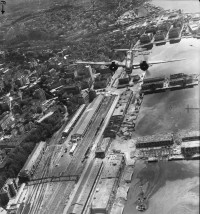
The exhibition develops a specific social dynamics by being staged in the Port of Rijeka at whose bottom Galeb, then called Kiebitz, spent three years after it had been sunk in the Allied Forces air-attack in 1944. Rijeka’s destiny in the 20th century is also filled with turbulences and dramas. The city survived radical changes of political organization, changes of countries it belonged to, physical division into Sušak and Fiume after the Second World War and the exodus of Italian population, economic peaks and financial recessions. All those historical layers make up a complex, traumatized and politically radicalized social being, particularly sensitive to the events of the recent past and their interpretation and thus prone to often dramatic and very emotional reactions to the inclusion and analyses of cultural facts about the city’s history. This is especially true of the period of D’Annunzio’s government (1919-1921) when, as far as our exhibition is concerned, the city saw a significant identification of life and art, that is, the realization of the futurist program. In 1919, ten years after the proclamation of the famous Futurist Manifesto, its author, Filippo Tommaso Marinetti and his legionaries celebrated D’Annunzio’s conquering escapade in Rijeka. And it was precisely the Futurist Manifesto published in 19093 and its radical program that broke up with the traditional social norms, conventions and aesthetics, and by celebrating the beauty of machine and industry, as well as revolution and war, inspired artists to step out of their ivory tower of disinterested artistic creativity and turn to artistic practices that would question the social context of art, its meaning and purpose, and that would in the coming decades seriously shake not only the horizon of artistic activity, but also make an important contribution to the society’s revolutionary transformation as well as the revolution in visual arts, and thus determine the visual culture we live in. Although Marinetti himself with time excluded numerous left-oriented futurists and turned to supporting and propagating Mussolini’s fascist revolution, his radicalism found the most fertile ground among artistic and radical intellectual circles that would start the October Revolution and constructivist and supremacist visual revolution that would forever change our civilization. As an unofficial publication of the city’s command, a legionnaire-futurist review called La testa di ferro was published in Rijeka from February 1 to June 20, 1920. With the poet Mario Carli as its editor, the magazine celebrated the Kvarner Republic and called for a new energy that would come out of the cooperation between workers and artists in a society of a new order similar to that of Soviet communist model. D’Annunzio’s orientation towards the Fascists and the Arditi did not tolerate this kind of radicalism and the magazine’s editors had to move to Milano. Rijeka is connected with yet another episode of the regional avant-garde period. Namely, after Zenit, the most important magazine for culture and arts in the region (1921-1926), was banned because of an article Zenitizam kroz prizmu marksizma (Zenitism Through the Prism of Marxism), its editor and founder Ljubomir Micić on the run from the police arrived to Rijeka where he as arrested and imprisoned on December 17, 1926. After Marinetti’s intervention, Micić was released already on December 23, 1926 and on January 17 the next year he and his wife leave Opatija and emigrate to Paris. With the inauguration of a manifesto as an ultimate, financially sustainable and immediate form of expanding programs and ideas to a wide circle of audience, the Futurist Movement indebted generations of artists until today. The advantages of the press inspired a true flood of folio editions, samizdat publications and magazines whose not only contents but, first and foremost, visual solutions, especially innovative typography and graphic design based on collage and photomontage techniques and reproductions of avant-garde works, fundamentally revolutionized visual culture, artistic forms, practices and strategies as well as those mainstream printed media and marketing. Avant-garde magazines became platforms not only for dissemination of information and programs, but, more important, channels of international and regional cooperation of artists and intellectuals. Zenit, which is of key importance for our region, collaborated with Kassak’s MA, in its typography, graphic design and contents it reflected the radicalism of the Soviet LEF Magazine as well as Teige’s Devětsil. Decades later, visual identity, typography and phrasing of the avant-garde press will make a decisive influence on the representatives of concrete and visual poetry of the 1960s and 1970s. The Dada Tank Magazine will have a decisive influence on Marko Pogačnik, who was at the time still a high school student, while the Zenit Magazine did the same for the representatives of neo and post avant-garde in Yugoslavia. Avant-garde magazines will also influence the emergence of their antithesis in a series of Gorgona anti-magazines. Belgrade surrealists at the turn of the second into the third decade of the 20th century closely collaborated with their Paris colleagues on magazines published on both sides, they also wrote and signed manifestos. The government proved to be particularly sensitive to the contents of the printed materials. Oskar Davičo’s arrest in 1932 marked an end of group activities of the Belgrade surrealist circle, and the closing continued next year with the arrests of Koča Popović and Đorđe Jovanović. All three of them were sentenced because of their favoring and promoting of communist attitudes. Samizdat publications proved to be equally disastrous for their authors. Marko Ristić’s long poem “Turpituda”, with the illustrations by Krsto Hegedušić, was confiscated and destroyed because of its criticism and subversion against the government in Zagreb in 1938, the same happened to Radovan Ivšić’s long poem “Narcis” in 1942 as well as Josip Stošić’s first collection of visual poetry in 1951 which saw the same destiny because of decadence, corruption of the youth and generally because of the contents inappropriate for the communist youth. Always the same arguments will be used in the explanations of different court rulings to magazines until deep into the 1970s and the 1980s. This introductory overview of the exhibition touches upon and illustrates only those key points the Standstill Exhibition is trying to affirm: people’s destinies, their conflict with the authorities, space and place of exhibition, themes of the appropriation of the symbols of authority, manifestos and art magazines. Artistic radicalism and the aesthetics of shock are even today, a whole century later, an inextricable part of active cultural heritage and an integral part of modern artistic strategies and techniques.
The concept of the Standstill Exhibition, by presenting a selection of examples of radical artistic practices from the Marinko Sudac Collection’s rich holdings aboard the Yugoslav Navy Training Ship Galeb, the famous Tito’s Ship of Peace, also inherits the method of radical confrontation of the content and context of presentation. Our goal, as well as that of the artists, is to bring the multilayered, concrete and historical meanings of Galeb as well as radical artistic practices together into a whole that would clearly show all of their cultural potential, and on the spiritual level inspire an open dialogue about historical events we repress and which despite or precisely because of that make a key spiritual horizon of our society and civilization. On a pragmatic level our goal is to give an impulse to the sustainable museological care of both segments of the exhibition in one of many possible variants of their common coexistence whose, we hope, only first edition is before you.
Branko Franceschi
1 Coincidences between such decisive cultural and political events can also be found a decade earlier, when in 1953 the exhibition of the EXAT 51 Art Group opened in Zagreb as the first exhibition of abstract art in the socialist world in a public institution, and Galeb sailed to London carrying Tito as the first president of a socialist country that ever visited Great Britain.
2 In support of the colleagues who organized the exhibition and the panel discussion at the Museum of Contemporary Art under the title For Active Art, it needs to be said that, besides that this is a direct citation of Ivan Picelj, one of the founders of the New Tendencies, in the context of today’s artistic production activism most often understands a formal approach to the exploration of social phenomena without expecting or even an ambition to influence them.
3 The Rijeka Futurist Manifesto was according to some authors published already in 1914.