


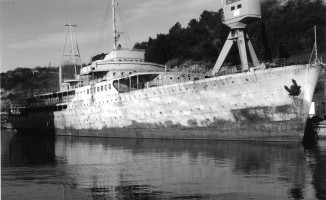
 galeb
galeb
INTRODUCTION
A couple of years ago a dear friend of mine Damir Miloš published a series of articles dedicated to the ship Galeb in his magazine called “Morsko Prase”. Today this same ship is home to an exhibition of activist art. This seemingly paradoxical turn – that the boat that used to serve for promotion and international identification of an ideological system now hosts an exhibition of art that stood up against such systems – in fact, has a cognitive quality. Just as it was unusual that a magazine dedicated to the sea, literature and arts in one of its issues focuses on recognizing the cultural value of a ship – which at that point was about to become a monument of culture –it is somewhat unexpected to set this exhibition on Galeb, but this is, in fact, an entirely radical move, which is in itself a kind of activism. A magazine, an exhibition, art and text exist and function as separate wholes, brought together around an object such as Galeb, but in cooperation they generate a surplus of information that shows some important qualities of ideological aspects of political ideology, as well as art. Because political ideology also begins its social affirmation with an activism of revolutionary type, often in cohesion with artistic activism, “Russian art experiment” not being the only argument in this thesis.
Activism is characteristic of both “mainstream” and “underground” levels of cultural activity, and while political ideology quickly turns into a dogma and gives up on activist questioning of everything including itself, artistic activism exhausts its very essence exactly in constant rejection of any kind of dogmatization. Modern social activism of any kind, and there are many, from environmental to economic and bio-diversity activism, is to a large measure based on the concept of “culture jamming”, that is, redefining, redesigning, reinterpreting, and reconstructing existing ideological contents (regardless of whether this is a political or consumerist ideology) in order to show how these information mechanisms function (Carducci 2006: 116-138). This is the case with the exhibition of activist art on Galeb – the reinterpreted surplus of information refers to the impossibility of talking about an individual work or works outside this context and it, first and foremost, demands a text about the context itself, and that is Galeb with all of its historical semiology “jammed” by this project. The concept of “culture jamming” is borrowed from communication technology where – most often on purpose – a radio signal is emitted in order to disable the transfer of message because it increases the level of noise, usually because of its impure frequency. This exhibition of activist art rises the noise level so that the concept and the very object of “Galeb” appear in a new sense, with the meaning of “a referential system, i.e. a system of meanings, which occupies the object’s emptied space” (Migliorini 1982: 284). This new Galeb is potentially a container of completely new meanings, different from the ones that describe it historically.
GALEB’S SOCIAL CONSTRUCTION
The ship’s history is rather unusual. It was made on order from the Italian company Regia Azienda Monopoli Banane (RAMB) from Genoa, which traded with fruit. In order to satisfy its European market, in 1936 RAMB Company ordered four fast diesel ships. The ships were built at Ansaldo Genova Shipyard in Italy, and the construction began in 1937. Galeb was then named RAMB III. When Italy declared war to Great Britain and France, the ship got its role in the war. Besides being a convoy escort, RAMB III also had the task of transporting meat for the Italian army stationed in Libya. On June 30, 1941, the ship was moored in the Libyan port of Benghazi when a torpedo from the British Submarine HMS Triumph hit its bow. The damage could not be repaired and the ship could not leave the port. Captain Giuseppe Aneti distributed the load so that the ship could sail but only astern. The ship sailed backwards some nine hundred miles from Libya to Sicily from where it was towed to San Marco Shipyard in Trieste.
After Italy capitulated in 1943 the ship, still at repairs, was captured by the German army. During 1944 the ship planted more than 5,000 mines in the Gulf of Kvarner and Northern Adriatic. On November 5, 1944 the Allied Forces aircrafts sunk the ship to the bottom of Rijeka Port where it lay at the depth of 22 meters. The operation of raising the ship commenced in 1947. At the beginning of 1948 the ship was resurfaced, partially disassembled and reconstructed at the shipyard in Pula. The ship was completely remodeled and given to the Yugoslav Navy as the Navy Training Ship Galeb although it mainly served as Josip Broz Tito’s floating residence. From March 1953, when he went to his first visit to Great Britain, Tito sailed on Galeb 14 time, visiting 18 countries and three continents – Europe, Asia and Africa – and anchored in 29 ports (in some more than once). During these voyages that lasted 478 days, Galeb crossed 85,000 nautical miles (157,420 kilometers). Many state officials and representatives of friendly countries, from British Prime Minister Winston Churchill, King Paul and Queen Frederika of Greece to Emperor Haile Selassie of Ethiopia and Hassan II of Morocco walked on Galeb’s decks, and it was also visited by presidents of Non-Aligned countries Gamal Abdel Nasser, Jawaharlal Nehru, Ahmed Sukarno, General Abboud, Kwame Nkrumah, Albert Tabnen, Habib Bourguiba, Sirimavo Bandaranaike, U Nu, Ne Win, Modibo Keita, Seku Ture, Archbishop Makariosa, as well as Nikita Khrushchev the President of the USSR.
At the beginning of the 1990s the ship retreated from Pula to Montenegrin port of Boka Kotorska. It remained there until the end of the decade, when it was bought by a Greek ship-owner who intended to turn it into a luxury yacht. Galeb was then towed to Viktor Lenac Shipyard where it would be remodeled. Due to the lack of money and other problems the ship spent a lot of time lying at dock and waiting for the situation to develop. The ship is still there. In May 2009 at an auction held at the Commercial Court in Rijeka, the City of Rijeka became Galeb’s new owner after the City took advantage of its right of pre-emption and the ship was auctioned off for 150,000 dollars.
This unusual turn of events, although so typical of transitional culture in the past twenty or so years, provides an immediate context for the exhibition of activist art, in other words, for giving the new and unexpected content to an object that is not an empty museum container whose meaning comes only from the exhibitions staged in it fill. No, Galeb is much more than just a ship, first and foremost, because of its ideological function, which it kept for a quarter of a century. Today’s “present absence” of Galeb in culture is a clear expression of its past social construction as a semantic carrier of all important characteristics of an ideological system that was based on the manipulation of elements of industrial modernization, and thus the technical excellence of the ship itself as well as the skill needed to operate it, enabled a global representative communication of the ideological system’s quality.
Until the moment it emptied itself of the function – with the disappearance of the social framework at the beginning of the 1990s – of a functional and semantic carrier of the leader of ideological system, Galeb was socially constructed through communication, which mostly operated on the level of mass media reporting on the political leader’s voyages. The voyage was always more than just a technical, maritime operation because it always carried a surplus of ideological meaning, depending on the importance of the destination and the reason for the voyage. Never in the period of its operative functionality was Galeb constructed as a place of cultural discourse or any other level of activism that would ask questions because, simply put, every level of its functionality was simply unquestionable.
Thus Galeb is already, even before the public opening of the exhibition of activist art, an object of some kind of “an archaeology of the immediate past” (Olivier 2001: 178-180) as today’s “hybrid construction” referring to the phenomenon of “the collective production of a past”. How long does it take from past to history? Before anything, we need an interpretative horizon, and the exhibition of activist art on Galeb establishes such a horizon by using the same activist methods art itself used before, and social activism uses today by applying the “culture jamming” method. In this sense, Galeb’s social construction goes on, but in a completely different interpretative key and thus, after this event, Galeb will no longer have the same meaning in the culture.
Even though it was a container of a meaning that glides fluidly, Galeb only now has the possibility of developing its potential as a true monument of culture, and not only an object of adoration of collectors and lovers of history. Namely, while the social elite developed its “objecthood” (as well as most other material carriers of ideological system), marginal art gave up on the objects or, if it did produce them, it reduced them to a minimum of materiality or, on the other hand, gave them some completely unexpected meanings (Fried 2009: 310)
THE IDEOLOGY OF ACTIVISM
What approaches are possible in activism as a tool of understanding the surplus of information? First, there is the one that demonstrates the obvious, that is, the one that artistically translates the everyday into a different context in order to make the hidden content clear. Good examples of such methods are the works of Ken Kesey and Marko Pogačnik.
At the end of the 1950s the American writer Ken Kesey, at the time still a creative writing student at Stanford, took part in an experiment that studied the effects of hallucinogenic drugs to the human psyche. At the beginning of the 1960s, probably inspired by his own experiences in the experiment, Kesey published the mega successful novel One Flew Over the Cuckoo’s Nest, which Miloš Forman later turned into a film. At the same time in Slovenia, Marko Pogačnik made an abstract sculpture in a rock in the Zarica Canyon near Kranj, the place where later numerous projects of the OHO Group would be located. The OHO Group emerged from a group of friends from school (Pogačnik, Geister, Ciglić) who caused a scandal when they published a school magazine called “Plemenice” that was later banned. Kesey, on the other hand, thanks to the commercial success of his book bought a property in the hills above San Francisco where he moved with his family and friends who would make the core of a group called the Merry Pranksters. There they experimented with psychoactive drugs at the time when LSD was still legal. In the fall of 1963 Pogačnik and Geister start school in Ljubljana and publish their first texts in the magazine called “Perspektive”.
On the occasion of publishing his second book Sometimes a Great Notion in 1964 Kesey had to travel to a book launch in New York so he bought an old school bus, painted it with his Merry Pranksters in vivid colors, loaded the bus with powerful audio equipment and went on a trip. Beat writer Neal Cassady spent most time at the wheel. The voyage was filled with public consummation of narcotics, which Kesey called “Acid Tests”, loud music and the fact that the members of this informal group dressed in a completely alternative fashion with regards to the standards of civil dress code. After two months on the road they arrived in New York where they met Ginsberg and Kerouac. In the same year in Lubljana, “Perspektive” was banned and the future members of the OHO Group established connections with the student weekly “Tribuna”, while Marko Pogačnik produced his first works by pouring plaster into a real object’s imprint in clay – which he called “pop articles”.
With occasional interruptions, the Merry Pranksters lasted until 1966 as an informal group of public provocateurs of civil standards, always acting as a multi-medial mixture of a happening, music and narco-theatre. When LSD got banned, and Timothy Leary – the guru of the psychedelic change of the world – kicked out of Harvard, Kesey’s group gradually became more and more private, but a the same time the hippie movement began to gather momentum taking over almost all of the elements of culture the Merry Pranksters brought into the scene. In 1968 in his book The Electric Kool Aid Acid Test Tim Wolfe describes the meaning and purpose of their activities as “a religious group” and “technological optimists”. References to that famous “bus of consciousness” are built in many works of popular culture from The Who onwards.
In 1966 Pogačnik published the Sintgalerija Manifest – a simple way of the democratization of an artistic institution in which everyone can take part. In the fall of the same year the manifest of the OHO Group, which by now already included Milenko Matanović and David Nez, was also published. Part of Pogačnik’s activities were public protests against the war in Vietnam. In 1968 the group had their first exhibitions staged in Ljubljana and Zagreb. At the beginning of the 1970s the group moved to the Village of Šempas, thus realizing their conviction that there should be no boundaries between life and art. Kesey died in 2001, after a decade of persistent promotion of getting to know one’s self and one’s environment, and even today Pogačnik in Šempas investigates the holistic image of man, energy and cosmos and delivers these ideas in the shape of geomantic interventions within problematic urban environments all over the world. But what it the connection between Kesey and Pogačnik, between the Merry Pranksters and the OHO Group? Their methods are seemingly different, but their idea is exactly the same – to expand one’s consciousness, comprehend oneself, and make society better. The only difference lies in the global modernization of the context, that is, in the civilizational level within which they were active. The fact that Pogačnik ironically referred to consumerist culture and that sound aggression and hallucinogenic trip are the necessary methods of making people realize and free themselves from the ideology of consumerist materialism are not without a cognitive value, just as Kesey noticed. Both of these methods are recognized and still used in “cultural jamming” with social activism of any kind (Dery, 1990).
ACTIVISM AS AN INTERPRETATION
Another approach to cognitive activism is philosophical and artistically communicative reconstruction, as practiced by Barthes and Warhol, which becomes obvious under special circumstances such as, for example, when two books appear simultaneously – albeit very late – in Croatian translation: Roland Barthes’ Mythologies and Warhol’s Popism: the Warhol Sixties, as witnesses of central processes of modernization. The books provide a context for a question that is now different than it would have been had it been asked years ago when the text was read in its original and then interpreted. Naturally, putting i such two differently perceived and culturally distant protagonists of culture of the 20th century n close connection means walking on slippery ground, but slipping in this sense is not without cognitive basis for the understanding of what they both, Barthes and Warhol, dealt with – and that is mass culture.
When in 1957 the first edition of Mytologies was published, Warhol was a busy and relatively well-know illustrator of fashion magazines, shop windows and record covers working in New York. There is no evidence that would show he had ever read or even known of Barthes’ book, and how could he – back then he was secretly making plans how to, together with his superstars, become the main icon of the subculture scene in New York of the 1960s, that is, to become the product of the same mass culture that fascinated him so much. If Barthes analyzed social myths “on the left”, Warhol’s position of a mythomaniac was completely opposite – “on the right”. Although not without irony towards this same position, this irony is perhaps an equally critical means as is Barthes’ bitter discourse. Warhol’s sixties are an exceptional biographical material coming from a decade that was marked by the dynamics of mass culture and its simultaneous criticism, and this criticism, philosophical and artistic, was expressed through different mediums and personalities which would allow someone to write a decent doctoral thesis on the subtle Barthes-Warhol connection, if it has not already been published at some university somewhere in the world. At the end of that world, where two translations were simultaneously offered to the public which can judge mass culture only in categories of political ideology, these two books help us understand the social construction of Galeb, at the time when it was in its original function, as well as today when it is being reconstructed through an exhibition of activist art.
If the ideology of activism is, first and foremost, a demonstration of the obvious, without the ideological lens, then the interpretative horizon is a necessary intellectual operation, which allows us to perceive even the intuitive interventions into existing political ideological structures as a stimulus to communicate that can after all be rationally explained. In other words, in order to understand what is the intention of an exhibition of activist – primarily marginal – art on a ship that is a symbol of ideological meaning, we need the memory of methods and activist interventions, ideas and works of Kesey, Pogačnik, Barthes and Warhol. They were the “culture jammers” par excellence.
THE EMANCIPATED SPECTATOR
Naturally, reminding of some artistic and intellectual activists is here just a model for accepting, as well as one of possible ways of interpreting, Galeb’s meaning today, even without the reconstructional addition provided by the exhibition. By keeping in mind the position of the “emancipated spectator” (Ranciere 2009: 5) and by understanding what Kesey, Pogačnik, Barthes and Warhol wanted, one can conclude that for this new understanding – in fact, an emancipation of viewing freed from sedimentations of a nostalgic, romanticized ideology – it is necessary to make a seemingly paradoxical step forward, even in order to make the original meaning clear. That’s why At a Standstill not only makes the activist art clear, but it also clears the field of meaning of the ship itself from the time when it was the carrier of ideological system. In this way “the history that became a form” (Groys 2010: 69) influences the fat that transitional reality often seems like a past artistic installation, that is, that contemporary reality unconsciously repeats the past artistic irony.
It anything different possible, that is, is it possible to reversibly direct the unconscious transfer of political into consumerist ideology into some more productive and more conscious model of social self-production? No matter to what extent this question understand some sort of activist approach or project, it seems that one such retroactive irony could serve as a contribution to the creation of new interpretative horizons for comprehending the ideologized culture.
Fedja Vukić
Bibliography
- CARDUCCI, Vince. 2006. Culture Jamming: A Sociological Perspective. Journal of Consumer Culture 6 (1)
- DERY, Mark. The Merry Pranksters And the Art of the Hoax. New York Times. December 23, 1990. Web. April 25, 2011. <http://www.nytimes.com/1990/12/23/arts/the-merry-pranksters-and-the-art-of-the-hoax.html>.
- FRIED, Michael. 2009. Art and Objecthood. In: CANDLIN, Fiona / GUINS, Raiford (eds.). The Object Reader. New York: Routledge
- GROYS, Boris. 2010. History Becomes Form, Cambridge: MIT Press.
- MIGLIORINI, Ermanno. 1982. Konceptualizam i lingvistički problemi. In: MIŠČEVIĆ, Nenad / ZINAIĆ, Milan (eds.). Plastički znak. Rijeka: Dometi.
- OLIVIER, Lauren. 2001. The Archaeology of the Contemporary Past. In: BUCHLI, Victor, / LUCAS, Gavin (eds.). The Archaeologies of the Contemporary Past. New York: Routledge.
- RANCIERE, Jacques. 2009. The Emancipated Spectator. London: Verso.