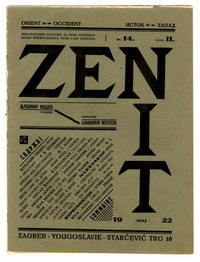
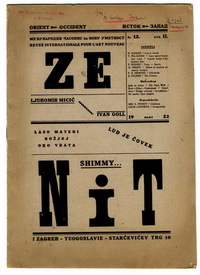
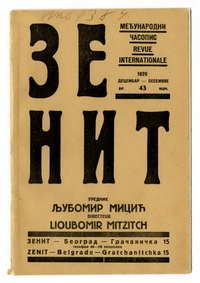
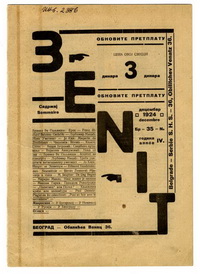
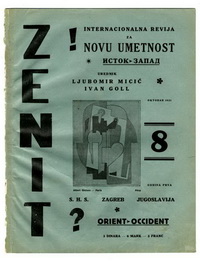
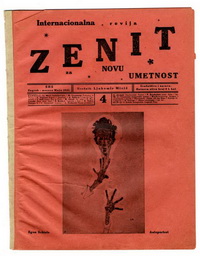
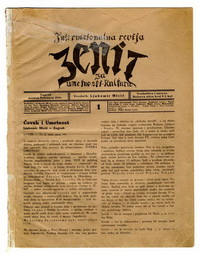
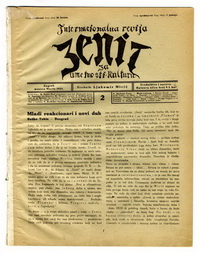
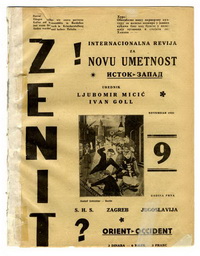
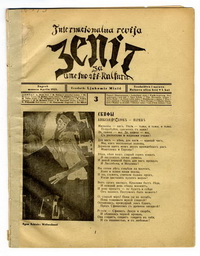
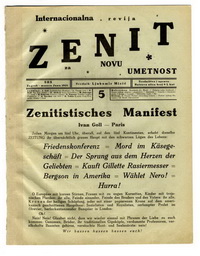
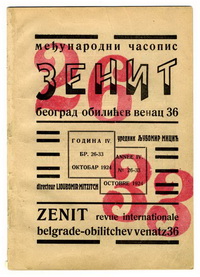
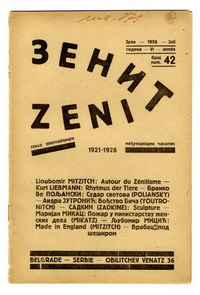
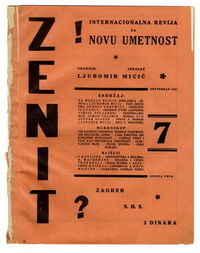
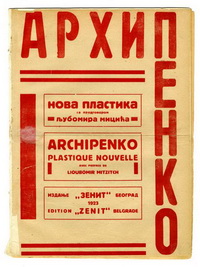
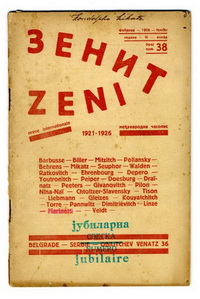
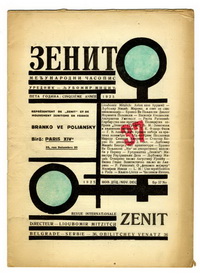
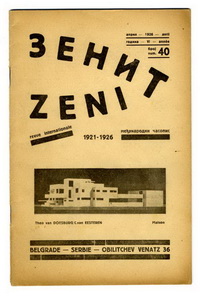
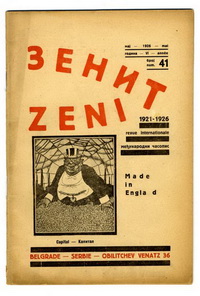
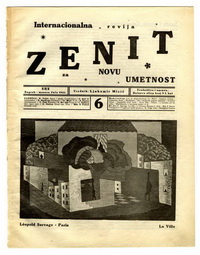
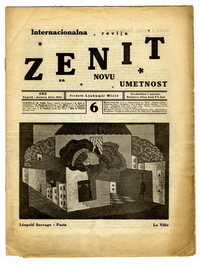
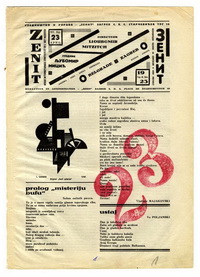
Avant-garde journal "Zenit" was initiated and edited by a poet, writer and critic Ljubomir Micić (1895-1971), who made it a journal of original program and poetics, of national and international level and importance. The "Zenit's" program opposes the European tradition and Eurocentrism in general, in the name of values built on assumptions of internal renewal of a man and overcoming the external materiality with internal content. The vision of a new and united Europe is proclaimed by a manifesto in the 10th issue of "Zenit". The manifesto represents the idea of the balkanisation of Europe, preceded by the resurrected Barbarogenij (barbarogenius – an internal incarnation of the Yugo(slav)-Balkanic man-hero), and the affirmation of the precultural, archaic and primordial forms of thinking and representation. "Zenit" thus became a program publication of various forms (posters, folioformat, catalog, etc.) and distinctive propaganda that, besides the leaflets, also included the famous Zenit evenings (Zagreb, Berlin, Munich, Paris, etc.). The journal emphasized its strategy of "disruption" with regular tributes of its issues: in February to Futurism and in October to the October Revolution. Some of the editors beside Micić were briefly Boško Tokin, Rastko Petrović, Ivan Goll and Branko Ve Poljanski, and of the "Russian edition" Ilja Erenburg and El Lisitzki. With its platform and aesthetic program, especially typographic arrengements, "Zenit" gathered all the relevant Yugoslav and many international artists such as: Walter Gropius, Velimir Khlebnikov, Kazimir Maljevič, Avgust Černigoj, Vilko Gecan, Mihail S. Petrov, Branko Ve Poljanski, Josip Seissel (Jo Klek) and Eduard Stepančič.
The journal ceased to be published after the ban of the 43rd issue, in 1926, because of an article of Dr. M Rasinov "Zenitism through the Prism of Marxism". The Court of Appeals brought charges against the editor Ljubomir Micić for allegedly spreading communist propaganda and indirectly calling the citizens to change the social order by force as it was during the Russian revolution. Political accusations have forced Micić to leave Belgrade on the night between December 15/16 of 1926 and via Zagreb and Sušak escape to Rijeka, where he was arrested on December 17. He stayed in prison until December 23 and was then released with the help of T. F. Marinetti. He emigrated to Paris on January 14 of 1927.
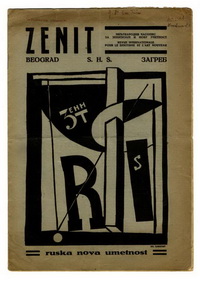
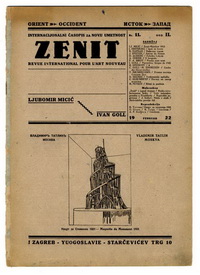
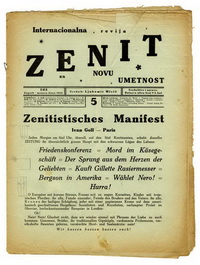
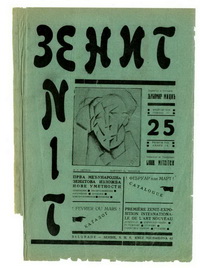 Zenit, periodical, 1921-1926, different dimesnions